

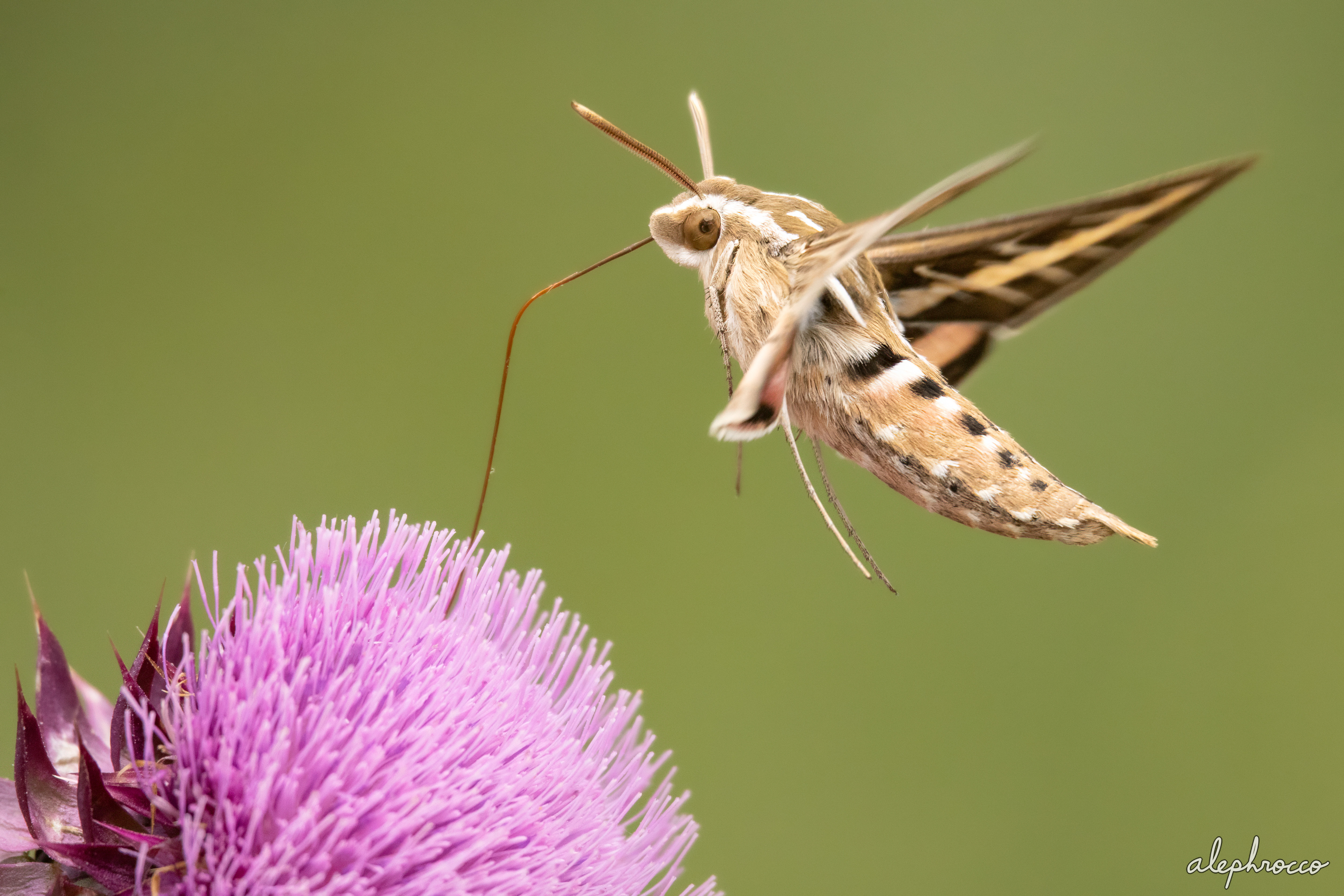
The white-lined sphinx moth (Hyles lineata) is one of the insects that most impacted me during my childhood. One evening, my parents had taken me for a walk in the local park. Suddenly, I heard a powerful flapping sound and gazed over to see a winged figure collide against a metal fence, flying vigorously but to no avail. It was already quite dark, and I rushed over to the fallen animal, expecting to find a bird or bat. However, it soon became clear it was actually a large type of moth. Being so little at the time, I was starstruck by the sheer size of the moth. I could barely keep it contained within my hands. No matter how securely I held the moth, its flight muscles twitched strongly, moving the torpedo-shaped body up and down. Disc-like palps came together neatly, enshrouding a long retracting tongue1 and also, as I would later learn, hearing organs sensitive into the ultrasonic2,3. Two large spherical eyes and a bulbous thorax gave the moth an endearing appearance. In that moment, I became completely enamored and convinced this was to be my favorite type of moth— no other could be so ideal. Although many moths have since astounded me, after all these years, I have remained faithful to the sphinx moths.
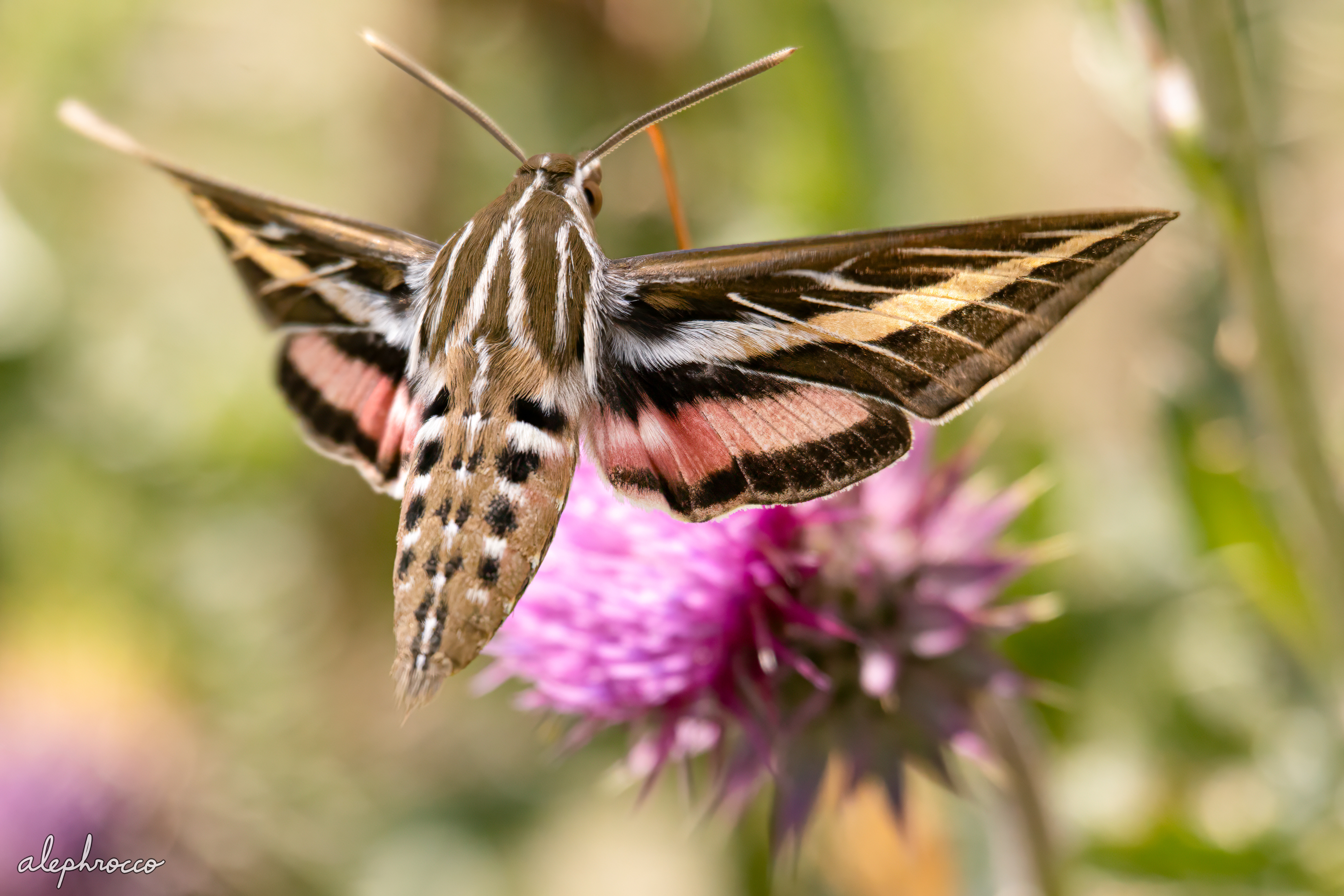
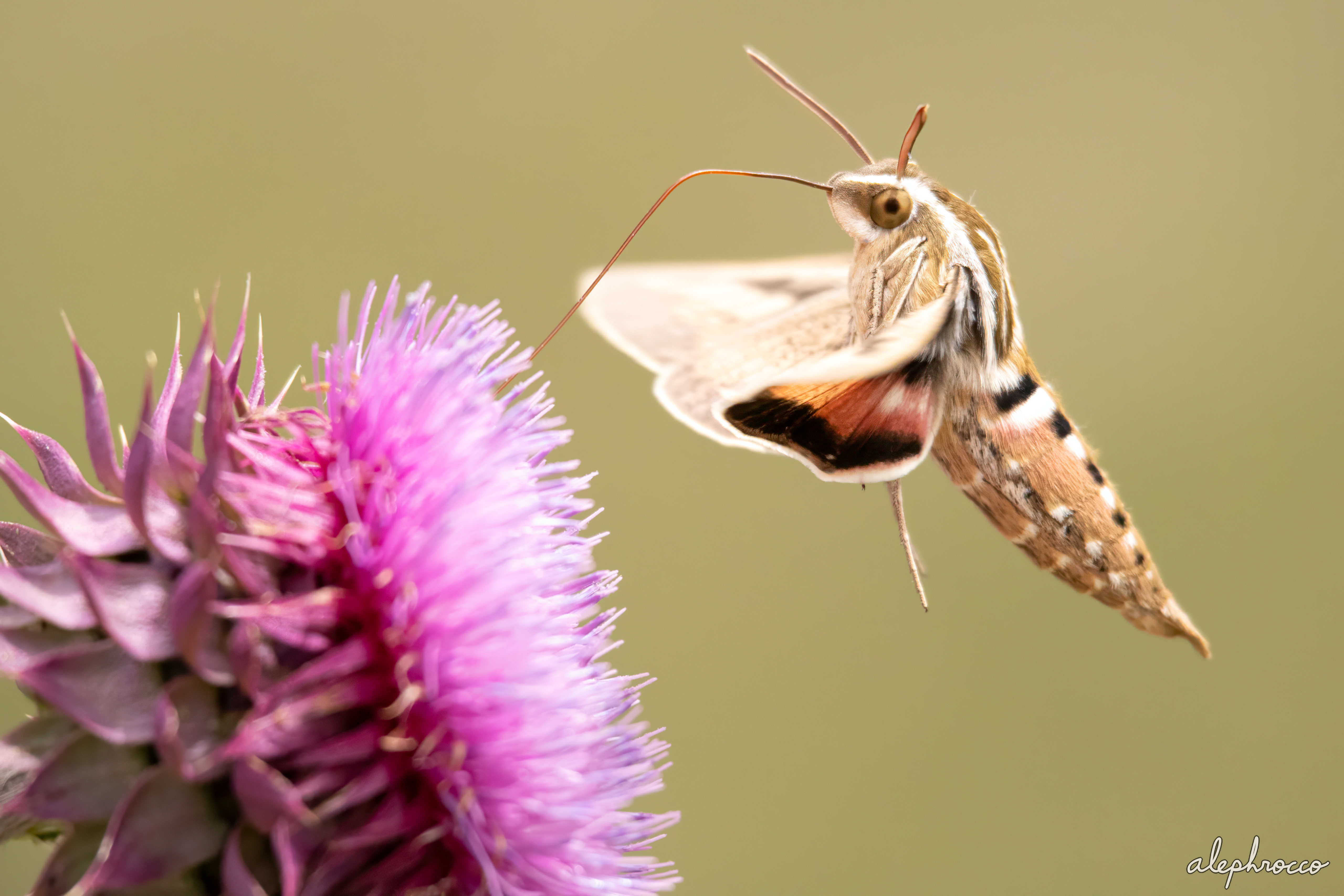
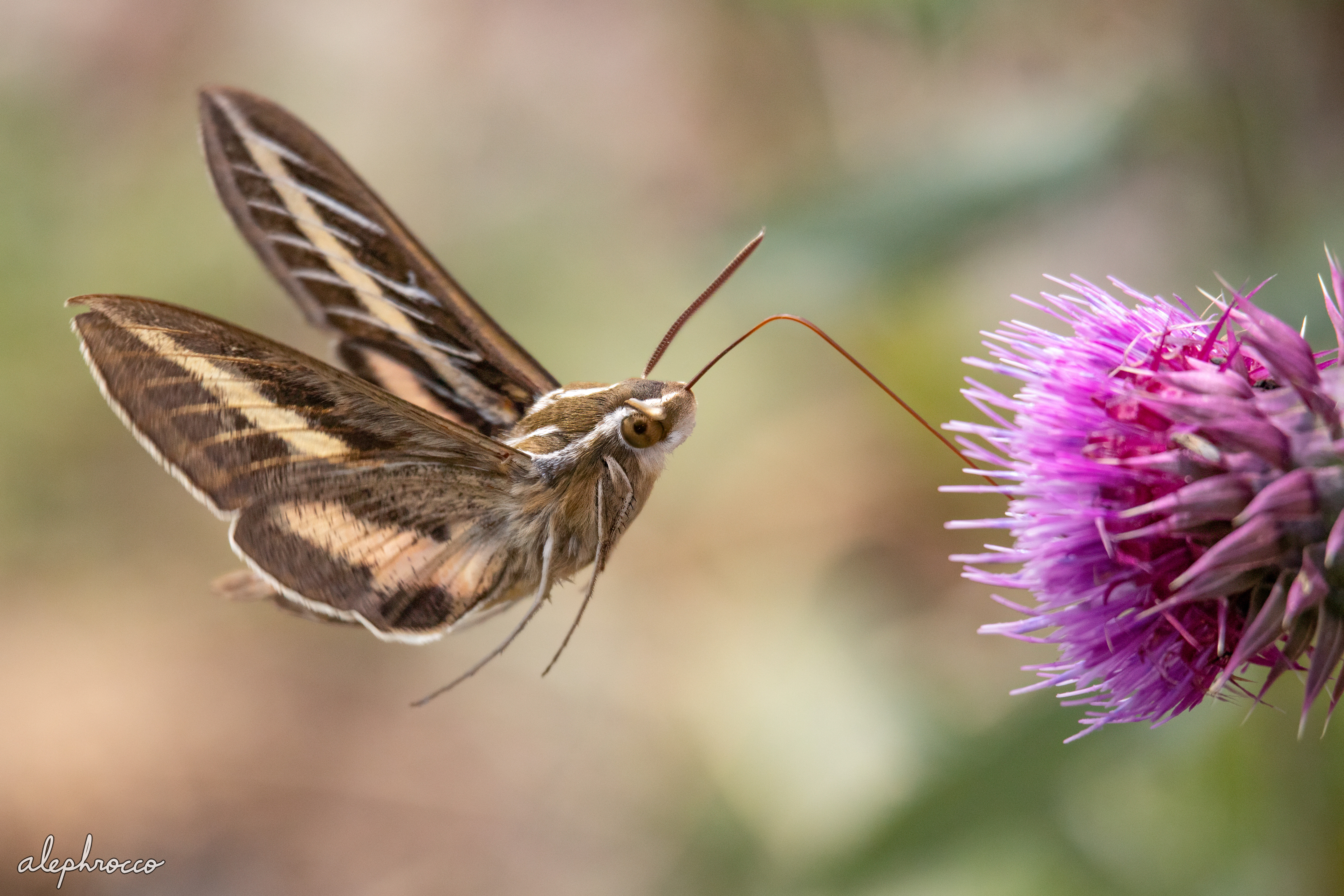
More recently, I traveled with my parents to Ruidoso, New Mexico, and white-lined sphinx moths were the first insects to greet us. I happened to be writing a short segment on Costa Rican sphinx moths just a few days earlier, and I loved being in their presence again. They flew far and near, primarily foraging on nectar from plume thistles (Cirsium sp.). Bumblebees, wasps, and flies were startled by their overpowering flight when the moths veered too close by. Only hummingbirds could take over their airspace. As the sky got darker and darker, the moths remained active, an ode to this species’ impressive ability to see effectively both by day and by night.
Night-active sphinx moths, including H. lineata, are adapted for low light vision4. Superposition eyes gather light input from multiple facets of the compound eye into a single processing unit (rhabdom), and a reflective layer (tapetum) and sheath double the amount of light captured by the retina5. These reflective surfaces give the moths eyeshine when a light is shone in their direction at night (much like a cat or owl!), and the aperture of the pseudopupil that shines back can be used to estimate the amount of light that enters their visual system6. Extremely low light, nonetheless, imposes major challenges for color vision, because the available light may not be enough to be resolved simultaneously by multiple photoreceptor classes7. Despite these limitations, several sphinx moths, including H. lineata, still manage to discriminate colors at light levels that are equivalent to illumination from starlight alone. Astonishingly, under these conditions, they are able to distinguish blues, yellows, greens, and changes in the ultraviolet8. Such a feat becomes even more awe-inspiring when thinking of how fast sphinx moths fly when moving between flower patches.
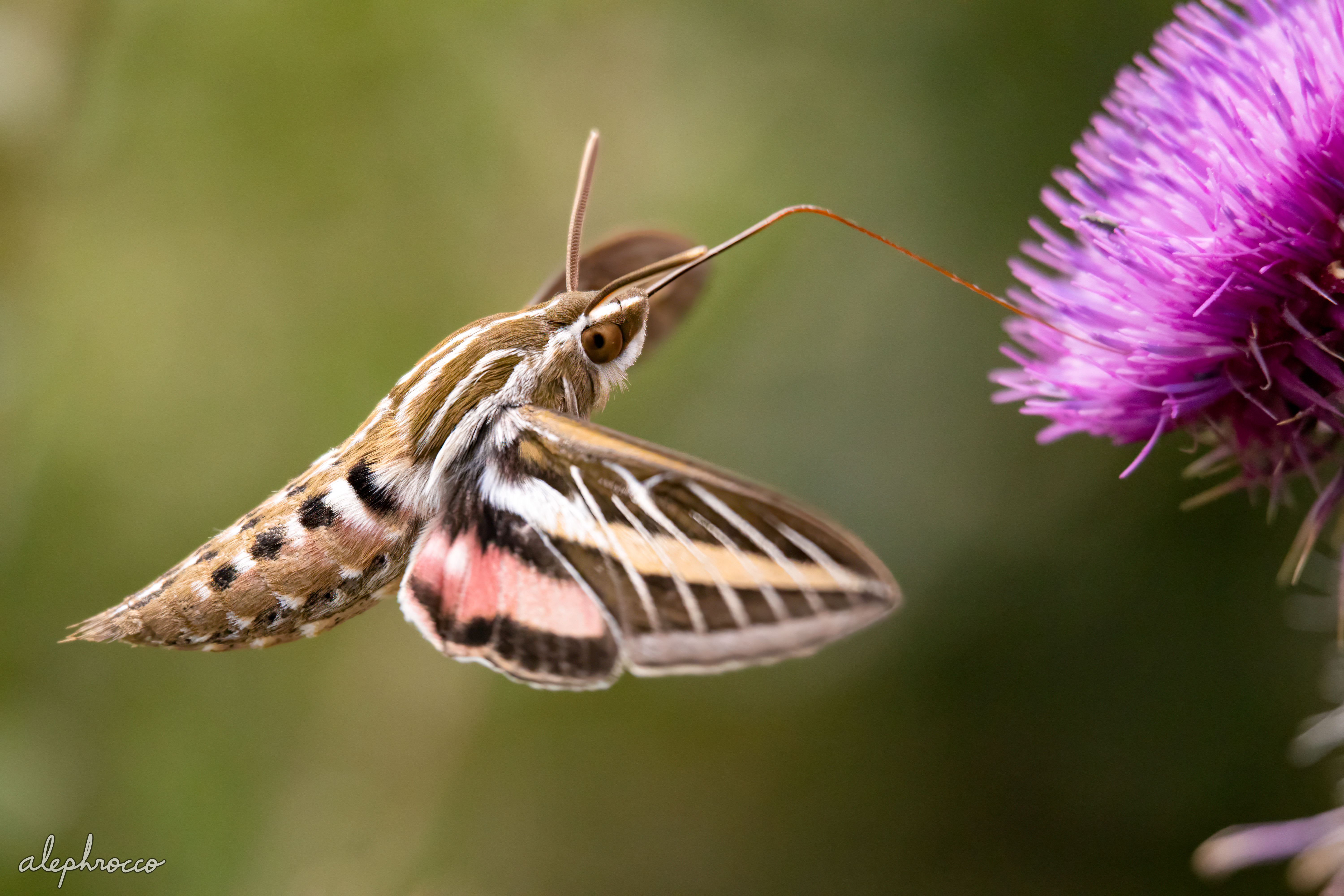
One proposed mechanism that grants the moths this ability is called color constancy. Relative light capture across photoreceptor classes remains similar across various ambient light conditions, which enables sphinx moths (e.g., Deilephila elpenor) to reliably identify colors during cool daylight and the transition into the warm glows of dawn and dusk8. As light levels continue to plummet, color constancy enhances color perception by reducing the effect of the changing light environment9. Higher-order processing in the brain further increases light sensitivity by summing light energy captured across neighboring facets (spatial summation) and over time (temporal summation), at the expense of resolution6. During the darkest cloudy nights, however, the moths may only be able to see white flowers, abandoning their color preferences and honing in on brightness as a visual cue8.
Nocturnality is not a recent innovation in sphinx moths; in fact, the entire Sphingidae family diversified from a nocturnal moth ancestor10. Diurnal species, on the other hand, show parallel changes in their visual systems, such as tuning their photoreceptor pigments to cover a narrower breadth of colors11. Although finer colors can be discriminated, light sensitivity is sacrificed, hindering low-light vision. For H. lineata, the species is able to excel at diurnal and nocturnal lifestyles. Its visual system may represent a compromise between both habits. Another possibility is that it adjusts dramatically to opposing light environments, perhaps in ways that have yet to be uncovered.
All photographs in situ [1]


- Nilsson, L. A. (1998). Deep flowers for long tongues. Trends in ecology & evolution, 13(7), 259-260.
- Roeder, K. D. (1972). Acoustic and mechanical sensitivity of the distal lobe of the pilifer in choerocampine hawkmoths. Journal of Insect Physiology, 18(7), 1249-1264.
- Göpfert, M. C., Surlykke, A., & Wasserthal, L. T. (2002). Tympanal and atympanal ‘mouth–ears’ in hawkmoths (Sphingidae). Proceedings of the Royal Society of London. Series B: Biological Sciences, 269(1486), 89-95.
- Kelber, A., & Roth, L. S. (2006). Nocturnal colour vision–not as rare as we might think. Journal of Experimental Biology, 209(5), 781-788.
- Stöckl, A., Smolka, J., O’Carroll, D., & Warrant, E. (2017). Resolving the trade-off between visual sensitivity and spatial acuity—lessons from hawkmoths. Integrative and Comparative Biology, 57(5), 1093-1103.
- Stöckl, A. L., O’Carroll, D., & Warrant, E. J. (2017). Higher-order neural processing tunes motion neurons to visual ecology in three species of hawkmoths. Proceedings of the Royal Society B: Biological Sciences, 284(1857), 20170880.
- Kelber, A., Balkenius, A., & Warrant, E. J. (2002). Scotopic colour vision in nocturnal hawkmoths. Nature, 419(6910), 922-925.
- Kelber, A., Balkenius, A., & Warrant, E. J. (2003). Colour vision in diurnal and nocturnal hawkmoths. Integrative and Comparative Biology, 43(4), 571-579.
- Johnsen, S., Kelber, A., Warrant, E., Sweeney, A. M., Widder, E. A., Lee Jr, R. L., & Hernández-Andrés, J. (2006). Crepuscular and nocturnal illumination and its effects on color perception by the nocturnal hawkmoth Deilephila elpenor. Journal of Experimental Biology, 209(5), 789-800.
- Huang, Y. X., Xing, Z. P., Zhang, H., Xu, Z. B., Tao, L. L., Hu, H. Y., … & Wang, X. (2022). Characterization of the complete mitochondrial genome of eight diurnal hawkmoths (Lepidoptera: Sphingidae): new insights into the origin and evolution of diurnalism in sphingids. Insects, 13(10), 887.
- Akiyama, T., Uchiyama, H., Yajima, S., Arikawa, K., & Terai, Y. (2022). Parallel evolution of opsin visual pigments in hawkmoths by tuning of spectral sensitivities during transition from a nocturnal to a diurnal ecology. Journal of Experimental Biology, 225(23), jeb244541.